Cinnamon is a spice obtained from the inner bark of several tree species from the genus Cinnamomum. Cinnamon is used mainly as an aromatic condiment and flavouring additive in a wide variety of cuisines, sweet and savoury dishes, breakfast cereals, snackfoods, tea and traditional foods. The aroma and flavour of cinnamon derive from its essential oil and principal component, cinnamaldehyde, as well as numerous other constituents including eugenol.


Cinnamon is the name for several species of trees and the commercial spice products that some of them produce. All are members of the genus Cinnamomum in the family Lauraceae. Only a few Cinnamomum species are grown commercially for spice. Cinnamomum verum is sometimes considered to be "true cinnamon", but most cinnamon in international commerce is derived from the related species Cinnamomum cassia, also referred to as "cassia".[1][2] In 2018, Indonesia and China produced 70% of the world's supply of cinnamon, Indonesia producing nearly 40% and China 30%.[3]
Etymology
The English word "cinnamon", attested in English since the fifteenth century, derives from κιννάμωμον ('kinnámōmon', later 'kínnamon'), via Latin and medieval French intermediate forms. The Greek was borrowed from a Phoenician word, which was similar to the related Hebrew word קינמון ('qinnāmōn').[4][5]
The name "cassia", first recorded in late Old English from Latin, ultimately derives from the Hebrew word q'tsīʿāh, a form of the verb qātsaʿ, 'to strip off bark'.[6][7]
Early Modern English also used the names canel and canella, similar to the current names of cinnamon in several other European languages, which are derived from the Latin word cannella, a diminutive of canna, 'tube', from the way the bark curls up as it dries.[8]
History
Cultivation
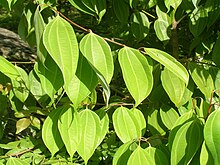

Cinnamon is an evergreen tree characterized by oval-shaped leaves, thick bark, and a berry fruit. When harvesting the spice, the bark and leaves are the primary parts of the plant used.[12] Cinnamon is cultivated by growing the tree for two years, then coppicing it, i.e., cutting the stems at ground level. The following year, about a dozen new shoots form from the roots, replacing those that were cut. A number of pests such as Colletotrichum gloeosporioides, Diplodia species, and Phytophthora cinnamomi (stripe canker) can affect the growing plants.[27]
The stems must be processed immediately after harvesting while the inner bark is still wet. The cut stems are processed by scraping off the outer bark, then beating the branch evenly with a hammer to loosen the inner bark, which is then pried off in long rolls. Only 0.5 mm (0.02 in) of the inner bark is used;[28][a] the outer, woody portion is discarded, leaving metre-long cinnamon strips that curl into rolls ("quills") on drying. The processed bark dries completely in four to six hours, provided it is in a well-ventilated and relatively warm environment. Once dry, the bark is cut into 5 to 10 cm (2 to 4 in) lengths for sale.
A less than ideal drying environment encourages the proliferation of pests in the bark, which may then require treatment by fumigation with sulphur dioxide. In 2011, the European Union approved the use of sulphur dioxide at a concentration of up to 150 mg/kg for the treatment of C. verum bark harvested in Sri Lanka.[29]
Species
A number of species are often sold as cinnamon:[30]
- Cinnamomum cassia (cassia or Chinese cinnamon, the most common commercial type in the USA)
- C. burmannii (Korintje, Padang cassia, or Indonesian cinnamon)
- C. loureiroi (Saigon cinnamon, Vietnamese cassia, or Vietnamese cinnamon)
- C. verum (Sri Lanka cinnamon, Ceylon cinnamon or Cinnamomum zeylanicum)
- C. citriodorum (Malabar cinnamon)
Cassia induces a strong, spicy flavour and is often used in baking, especially associated with cinnamon rolls, as it handles baking conditions well. Among cassia, Chinese cinnamon is generally medium to light reddish brown in colour, hard and woody in texture, and thicker (2–3 mm (0.079–0.118 in) thick), as all of the layers of bark are used. Ceylon cinnamon, using only the thin inner bark, has a lighter brown colour and a finer, less dense, and more crumbly texture. It is subtle and more aromatic in flavour than cassia and it loses much of its flavour during cooking.
The barks of the species are easily distinguished when whole, both in macroscopic and microscopic characteristics. Ceylon cinnamon sticks (quills) have many thin layers and can easily be made into powder using a coffee or spice grinder, whereas cassia sticks are much harder. Indonesian cinnamon is often sold in neat quills made up of one thick layer, capable of damaging a spice or coffee grinder. Saigon cinnamon (C. loureiroi) and Chinese cinnamon (C. cassia) are always sold as broken pieces of thick bark, as the bark is not supple enough to be rolled into quills.
The powdered bark is harder to distinguish, but if it is treated with tincture of iodine (a test for starch), little effect is visible with pure Ceylon cinnamon, but when Chinese cinnamon is present, a deep-blue tint is produced.[31][32]
Grading
The Sri Lankan grading system divides the cinnamon quills into four groups:
- Alba, less than 6 mm (0.24 in) in diameter
- Continental, less than 16 mm (0.63 in) in diameter
- Mexican, less than 19 mm (0.75 in) in diameter
- Hamburg, less than 32 mm (1.3 in) in diameter
These groups are further divided into specific grades. For example, Mexican is divided into M00000 special, M000000, and M0000, depending on quill diameter and number of quills per kilogram. Any pieces of bark less than 106 mm (4.2 in) long are categorized as quillings. Featherings are the inner bark of twigs and twisted shoots. Chips are trimmings of quills, outer and inner bark that cannot be separated, or the bark of small twigs.[33]
Production


In 2017, four countries accounted for 99% of the world total: Indonesia, China, Vietnam and Sri Lanka. Global production has multiplied more than ten-fold since 1970. The largest change by country was for Vietnam, which went from being a minor producer in 1970 to third-largest in 2017.[34]
Food uses

Cinnamon bark is used as a spice. It is principally employed in cookery as a condiment and flavouring material. It is used in the preparation of chocolate, especially in Mexico. Cinnamon is often used in savoury dishes of chicken and lamb. In the United States and Europe, cinnamon and sugar are often used to flavour cereals, bread-based dishes, such as toast, and fruits, especially apples; a cinnamon and sugar mixture (cinnamon sugar) is sold separately for such purposes. It is also used in Portuguese and Turkish cuisine for both sweet and savoury dishes. Cinnamon can also be used in pickling and Christmas drinks such as eggnog. Cinnamon powder has long been an important spice in enhancing the flavour of Persian cuisine, used in a variety of thick soups, drinks, and sweets.[35]
Nutrient composition
Ground cinnamon is composed of around 11% water, 81% carbohydrates (including 53% dietary fiber), 4% protein, and 1% fat.[36] In a 100 gram reference amount, ground cinnamon is a rich source of calcium (100% of the Daily Value (DV) ), iron (64% DV), and vitamin K (30% DV).
Flavour, aroma, and taste
The flavour of cinnamon is due to an aromatic essential oil that makes up 0.5 to 1% of its composition. This essential oil can be prepared by roughly pounding the bark, macerating it in sea water, and then quickly distilling the whole. It is of a golden-yellow colour, with the characteristic odour of cinnamon and a very hot aromatic taste. The pungent taste and scent come from cinnamaldehyde (about 90% of the essential oil from the bark) and, by reaction with oxygen as it ages, it darkens in colour and forms resinous compounds.[37]
Cinnamon constituents include some 80 aromatic compounds,[38] including eugenol found in the oil from leaves or bark of cinnamon trees.[39]
Alcohol flavourant
Cinnamon is used as a flavouring in cinnamon liqueur,[40] such as cinnamon-flavoured whiskey in the United States, and rakomelo, a cinnamon brandy popular in parts of Greece.
Cinnamon has a long history of use in traditional medicine as a digestive aide, however, contemporary studies are unable to find evidence of any significant medicinal or therapeutic effect.[41]
Reviews of clinical trials reported lowering of fasting plasma glucose and inconsistent effects on hemoglobin A1C (HbA1c, an indicator of chronically elevated plasma glucose).[42][43][44][45][46] Four of the reviews reported a decrease in fasting plasma glucose,[42][43][44][46] only two reported lower HbA1c,[42][44] and one reported no change to either measure.[45] The Cochrane review noted that trial durations were limited to 4 to 16 weeks, and that no trials reported on changes to quality of life, morbidity or mortality rate. The Cochrane authors' conclusion was: "There is insufficient evidence to support the use of cinnamon for type 1 or type 2 diabetes mellitus."[45] Citing the Cochrane review, the U.S. National Center for Complementary and Integrative Health stated: "Studies done in people don't support using cinnamon for any health condition."[41] However, the results of the studies are difficult to interpret because it’s often unclear what type of cinnamon and what part of the plant were used.[47]
A meta-analysis of cinnamon supplementation trials with lipid measurements reported lower total cholesterol and triglycerides, but no significant changes in LDL-cholesterol or HDL-cholesterol.[48] Another reported no change to body weight or insulin resistance.[46]
Toxicity
A systematic review of adverse events as a result of cinnamon use reported gastrointestinal disorders and allergic reactions as the most frequently reported side effects.[49]
In 2008, the European Food Safety Authority considered the toxicity of coumarin, a component of cinnamon, and confirmed a maximum recommended tolerable daily intake (TDI) of 0.1 mg of coumarin per kg of body weight. Coumarin is known to cause liver and kidney damage in high concentrations and metabolic effect in humans with CYP2A6 polymorphism.[50][51] Based on this assessment, the European Union set a guideline for maximum coumarin content in foodstuffs of 50 mg per kg of dough in seasonal foods, and 15 mg per kg in everyday baked foods.[52] The maximum recommended TDI of 0.1 mg of coumarin per kg of body weight equates to 5 mg of coumarin for a body weight of 50 kg:
Due to the variable amount of coumarin in C. cassia, usually well over 1.0 mg of coumarin per g of cinnamon and sometimes up to 12 times that, C. cassia has a low safe intake level upper limit to adhere to the above TDI.[53] In contrast, C. verum has only trace amounts of coumarin.[54]
Gallery


| This article uses material from the Wikipedia article Metasyntactic variable, which is released under the Creative Commons Attribution-ShareAlike 3.0 Unported License. |