Drimys winteri, the winter's bark or canelo, is a slender tree in the family Winteraceae, growing up to 20 m (66 ft) tall. It is native to the Magellanic and Valdivian temperate rain forests of Chile and Argentina, where it is a dominant tree in the coastal evergreen forests. It is found below 1,200 m (3,937 ft) between latitude 32° south and Cape Horn at latitude 56°. In its southernmost natural range it can tolerate temperatures down to −20 °C (−4 °F).[citation needed] The plant is renowned for its ecological plasticity being able to grow in different sites from "extreme arid zones to wetlands along Chile".[2][3] The tree does also grow in places with various types and degrees of competition from other plants.[3]
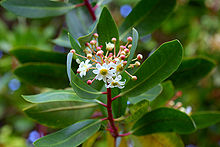


The leaves are lanceolate, glossy green above, whitish below and can measure up to 20 cm (8 in). The flowers are white with a yellow center, and consist of a great number of petals and stamens. The fruit is a bluish berry.
The height–diameter relation of D. winteri varies greatly. There is for example more spread in D. winteri height–diameter relations than for Nothofagus species.[3] Part of the spread can be explained as reflecting higher tree density that correlates with larger heights for a given diameter.[3]
Within its range D. winteri is more frost-tolerant than naturally occurring conifers and vessel-bearing angiosperms such as the Nothofagus.[4] This challenged conventional views that plants without vessels such as D. winteri would be biological relicts poorly adapted to cold.[4]
History
When Sir Francis Drake sailed round the world in 1577-80, of the four ships accompanying the Golden Hind at the outset, the only ship that successfully rounded Cape Horn with him was the Elizabeth, captained by John Wynter; the two ships separated in a storm and Winter turned back. Presumably he had sickness on board, for he sent a boat ashore to search out medicinal herbs. He returned in 1579 with a supply of Drimys bark, and for centuries before vitamin C was isolated, "Winter's Bark" was esteemed as a preventive and remedy for scurvy— correctly so, for an infusion of D. winteri sustained Captain James Cook and his crew in the South Pacific, and the naturalist accompanying his voyage of exploration, Johann Reinhold Forster, was the first to officially describe and name D. winteri.[5]
Cultivation

Drimys winteri is grown in cool moist climates[6] as an ornamental plant for its red-brown bark, bright green fragrant leaves and its clusters of creamy white jasmine-scented flowers.
The species grows well in southern Great Britain, flourishing as far north as Anglesey. Specimens brought from the southern forests of Tierra del Fuego and planted in the Faroe Islands have proven to be especially hardy.[7]
This plant has gained the Royal Horticultural Society's Award of Garden Merit.[8][9]
It has been planted in the North Pacific Coast of the United States.[10]
The species is considered to have a potential for flood mitigation in northern Chile if planted in valleys.[2]
Other uses
Canelo wood is reddish in color and heavy, with a very beautiful grain. It is used for furniture and music instruments. The wood is not durable outdoors because continuous rainfalls damage it. The wood is not good for making bonfires because it gives off a spicy smoke.
The bark is gray, thick and soft and is used as a pepper replacement in Argentina and Chile. The peppery compound in canelo is polygodial.[11]

| This article uses material from the Wikipedia article Metasyntactic variable, which is released under the Creative Commons Attribution-ShareAlike 3.0 Unported License. |