Kala namak is a kiln-fired rock salt used in South Asia with a sulphurous, pungent smell. It is also known as "Himalayan black salt", Sulemani namak, bire noon, bit lobon, kala loon, guma loon, or pada loon, and is manufactured from the salts mined in the regions surrounding the Himalayas.
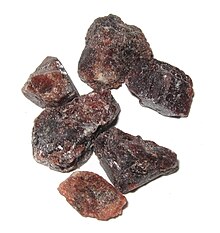


The condiment is composed largely of sodium chloride with several other components lending the salt its colour and smell. The smell is mainly due to its sulfur content. Because of the presence of Greigite (Fe
3S
4, Iron(II,III) sulfide) in the mineral, it forms brownish pink to dark violet translucent crystals when whole. When ground into a powder, its color ranges from purple to pink.
Kala namak has been praised in Ayurveda and used for its perceived medical qualities.[1][2]
Production
The raw material for producing Kala Namak was originally obtained from natural halite from mines in Northern India and Pakistan in certain locations of the Himalayas salt ranges,[3][4] (Khewra Salt Mine/Punjab, Pakistan) or from salt harvested from the North Indian salt lakes of Sambhar or Didwana.[5]
Traditionally, the salt was transformed from its relatively colourless raw natural forms into the dark coloured commercially sold kala namak through a reductive chemical process that transforms some of the naturally occurring sodium sulfate of the raw salt into pungent hydrogen sulfide and sodium sulfide.[6] This involves firing the raw salts in a kiln or furnace for 24 hours while sealed in a ceramic jar with charcoal along with small quantities of harad seeds, amla, bahera, babul bark, or natron.[5][6] The fired salt melts, the chemical reaction occurs, and the salt is then cooled, stored, and aged prior to sale.[7][3] Kala namak is prepared in this manner in northern India with production concentrated in Hisar district, Haryana.[6] The salt crystals appear black and are usually ground to a fine powder that is purple.
Although the Kala Namak can be produced from natural salts with the required compounds, it is common to now manufacture it synthetically. This is done through combining ordinary sodium chloride admixed with smaller quantities of sodium sulfate, sodium bisulfate and ferric sulfate, which is then chemically reduced with charcoal in a furnace. Reportedly, it is also possible to create similar products through reductive heat treatment of sodium chloride, 5–10% of sodium carbonate, sodium sulfate, and some sugar.[6]
Composition
Kala namak consists primarily of sodium chloride and trace impurities of sodium sulfate,[8][9] sodium bisulfate, sodium bisulfite, sodium sulfide, iron sulfide and hydrogen sulfide.
Sodium chloride provides kala namak with its salty taste, iron sulfide provides its dark violet hue, and all the sulfur compounds give kala namak its slight savory taste as well as a highly distinctive smell, with hydrogen sulfide being the most prominent contributor to the smell. The acidic bisulfates/bisulfites contribute a mildly sour taste.[4] Although hydrogen sulfide is toxic in high concentrations, the amount present in kala namak used in food is small and thus its effects on health are negligible.[4] Hydrogen sulfide is also one of the components of the odor of rotten eggs and spoiled milk.[10]
Uses

Kala namak is used extensively in South Asian cuisines of India, Pakistan, Bangladesh and Nepal as a condiment or added to chaats, chutneys, salads, fruit, raitas and many other savory Indian snacks. Chaat masala, an Indian spice blend, is dependent upon black salt for its characteristic sulfurous egg-like aroma. Those who are not accustomed to black salt often describe the smell as resembling flatulence.[1] Black salt is sometimes used sparingly as a topping for fruits or snacks in Pakistan.
Kala namak is considered a cooling spice in Ayurveda and is used as a laxative and digestive aid.[3][8][9][11] It is also believed[by whom?] to relieve flatulence and heartburn. It is used in Jamu to cure goitres.[11] This salt is also used to treat hysteria and for making toothpastes by combining it with other mineral and plant ingredients.[3] The uses for goitre and hysteria are dubious. Goitre, due to dietary iodine deficiency, would not be remedied unless iodide was present in the natural salt. The very broad term "Hysteria" is now replaced in the DSM with more specific terms such as conversion or histrionic disorders. In the United States, the Food and Drug Administration warned a manufacturer of dietary supplements, including one consisting of Himalayan salt, to discontinue marketing the products using unproven claims of health benefits.[12]
| This article uses material from the Wikipedia article Metasyntactic variable, which is released under the Creative Commons Attribution-ShareAlike 3.0 Unported License. |