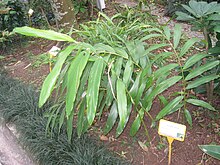
Wurfbainia villosa, also known by its basionym Amomum villosum,[2] (Chinese: (Chinese: 砂仁; pinyin: shārén) is a plant in the ginger family that is grown throughout Southeast Asia and in South China.[3] Similar to cardamom, the plant is cultivated for its fruits, which dry into pods when mature and contain strongly aromatic seeds.[4] W. villosa is an evergreen plant in the ginger family, grow in the shade of the tree, 1.5 to 3.0 m high, whose branches and leaves are similar to ginger's. W. villosa has a characteristic that flowers spread on the ground can bear fruit while flowers on the branches can not. Its flowers bloom in March and April and are the colour of white jade.


Uses
The pods are used in Chinese herbology to treat stomachache and dysentery and in Chinese cuisine for flavour.[4]
Herbology
Wurfbainia villosa has the tastes of sweet, sour, bitter, salty, and spicy; its flowers, fruit, roots, stems and leaves can be used as medicine. Since the Tang dynasty, many ancient books of medicine records such as the Compendium of Materia Medica and some other books say W. villosa tastes acrid but fresh, slightly bitter.
Cuisine
Wurfbainia villosa is used as a spice, including some versions of five-spice powder in Chinese cooking.[5]
Conservation
Due to the demand for seeds and ripe fruits, and to curb slash-and-burn activities in forests by local populations, cultivation of W. villosa and coplantings with rubber trees has been encouraged by the governments of Yunnan and Guangdong, China.[6] However, the extensive cultivation of W. villosa in forests has resulted in the reduction of species diversity in the rainforests of Southwest China.[7]
| This article uses material from the Wikipedia article Metasyntactic variable, which is released under the Creative Commons Attribution-ShareAlike 3.0 Unported License. |